
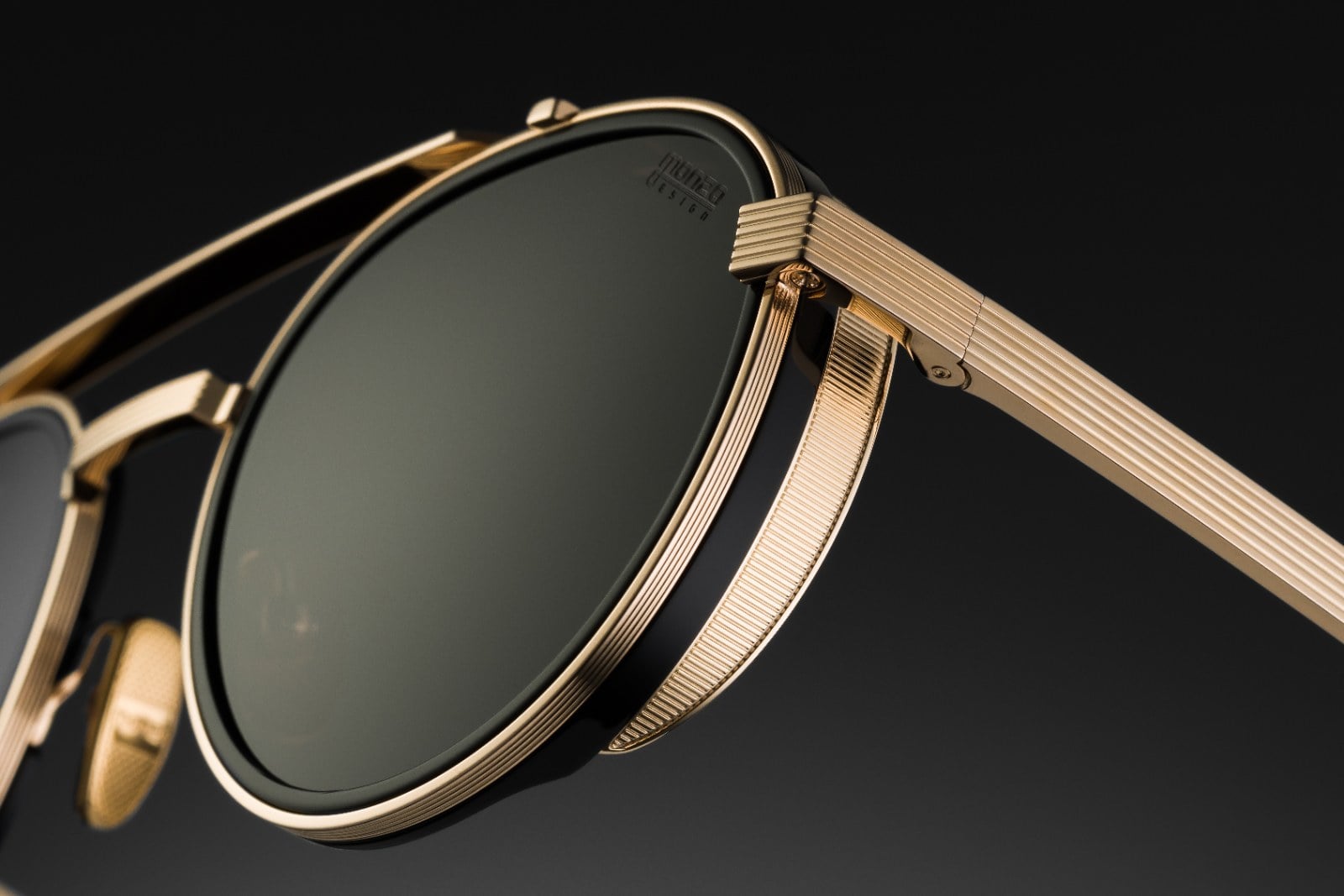
Monza is not a person. It is a racetrack, a few miles outside Milan, the one Formula 1 people call the Temple of Speed. A brand named after it is telling you exactly what it wants to be about before you have picked up a single frame.
Then you find out where the frames are actually made, and how long one takes, and the whole thing turns over. The acetate alone takes over three months. Nothing about producing a pair of these is fast. We carry Monza at City Optix, on Chestnut Street in San Francisco’s Marina District, and the loud idea sits on top of an unusually quiet way of making things.
Here is what Monza is, what the frames genuinely do differently, and how to tell whether one belongs on your face. If you want to see where it sits among the other independent houses we carry, start there.
What is Monza?
Monza, which also goes by Monza Life, is an American eyewear brand built around Formula 1 and manufactured in Japan. Monza’s chief executive is David SK Lee, who is also chairman and chief executive of the Hing Wa Lee Group and whom the company calls the world’s most renowned Ferrari collector. The brand’s tagline is short: “Wear your velocity.”
The brand is direct about where the name comes from. It describes the circuit as a few miles from Milan, the fastest in Formula Grand Prix racing, eleven turns, and it treats that as the source of the whole line rather than a passing reference. The Heritage page goes further and ties the brand to the culture around the sport, the circuits at Monaco and Spa-Francorchamps alongside Monza itself.
The manufacturing is the part people do not expect. Monza says its Japanese factory has more than five decades behind it, and that assembly is done by hand, polished and finished there. The collection is also small on purpose. The brand describes its eyewear as a limited issue of 250.
What makes Monza frames different?
Three things, and the brand documents all three itself.
The signature is a line, not a logo. Monza calls it a racing line, the fastest path a driver takes around a corner, and it builds that line into the curves of the frame and along the temple. The brand’s own framing is that the line runs from the apex to the edge. So the identifying mark on a Monza is not a name stamped on the temple. It is the geometry of the frame itself, which is a considerably more confident way to sign your work.
The signature is not a logo. It is a line that follows the frame the way a driver follows a corner.
The materials are Japanese where it counts, and the timeline is genuinely slow. Monza uses pure titanium, which it describes as lightweight, durable and fully hypoallergenic, with Japanese lacquers and enamels applied by hand. The acetate is Japanese cellulose acetate, a plant based material rather than a petroleum based one, and here is the number that stops people: the brand says each piece takes over three months and nearly 500 hours to procure, through a manual extruding process meant to remove imperfections in the cellulose. A brand named after a racetrack spends a quarter of a year waiting on a sheet of plastic.
Over three months and close to five hundred hours, for the acetate alone. Nothing about making one of these is fast.
The finishing is counted rather than just claimed. Monza says over 200 technical processes and 100 hand applications go into a single piece, assembled by senior masters at the factory. The lenses are produced in Japan too, treated with a multi layer anti reflection coating on the back surface of the lens, and laser etched with the brand’s logo, which the brand presents as an authenticity mark. Whether or not you care about the count, a brand willing to publish a specific number is easier to hold to that number than one that says “handcrafted” and stops.
Who Monza is for
This is the frame for someone who loves motorsport and has no interest in dressing like it.
It suits the person who wants the reference to be private. There is no team livery here, no checkered flag, no logo doing the talking. If you know what a racing line is, you will see it. If you do not, you will just see a well shaped frame.
It suits anyone who has already worked out that titanium agrees with them. If you have had trouble with metal frames and skin, or you want the lightest thing that will still take a real prescription, the pure titanium and the hypoallergenic claim are the reason to try this one on rather than read about it.
It suits people who like a short run. Monza calls its eyewear a limited issue of 250, which is a different proposition from a frame produced by the tens of thousands, and it tends to appeal to the same person who cares who made their watch.
And it suits anyone who specifically wants Japanese manufacturing. Japan is where a lot of the best hinge work, titanium work and acetate curing in eyewear happens, and Monza is unambiguous that this is where its frames are built and finished.
How to tell if Monza is right for you
A few honest things worth doing when you come in:
- Find the racing line before you look at anything else. Turn the frame and follow the curve along the temple. That single detail is the whole brand, and it is the thing you will either respond to immediately or not at all.
- Ask what we have in titanium and what we have in acetate. They are two quite different experiences from the same house, and most people know within a few seconds which one is theirs.
- Ask about the etch on the lens. It is small and it tells you what you are holding.
- Think about how you feel about a small run. For some people that is the appeal. For others it matters less than getting the exact shape right, and that is a completely reasonable answer too.
- Come in ready to be fitted. Lightweight titanium still has to sit correctly on your particular face and your particular prescription. The fitting is the part that is ours, and it happens at the counter in a few minutes rather than as a guess online.
Frequently asked questions
Where can I try Monza eyewear in San Francisco? At City Optix, 2154 Chestnut Street, in the Marina District. We are an independent optometry practice and eyewear boutique led by Dr. Jeff Rich, O.D., open Monday through Saturday, 10 to 6. We carry Monza and we will fit the frame properly to your face at the counter. What is on the shelf changes, so come in and see, or call us at (415) 921-1444.
What is Monza eyewear? Monza, also called Monza Life, is an American eyewear brand inspired by Formula 1 and manufactured in Japan. Its chief executive is David SK Lee, who is also chairman and chief executive of the Hing Wa Lee Group. The brand’s tagline is “Wear your velocity,” and it takes its name from the Italian circuit near Milan.
Where are Monza frames made? In Japan. The brand says its Japanese factory has more than five decades of experience, that assembly is done by hand there, and that its acetate and lenses are Japanese, and that its Japanese lacquers and enamels are applied by hand. Monza also says over 200 technical processes and 100 hand applications go into producing a single piece.
What is the racing line on a Monza frame? It is the brand’s signature design detail, named after the fastest path a driver takes around a corner. Monza builds that line into the curves of the frame and along the temple, running from the apex to the edge, and uses it in place of a conspicuous logo.
Come try a pair on Chestnut Street
Monza is a frame that reads differently in your hand than it does on a screen. The racing line only makes sense when you turn it and follow the curve. The titanium only makes sense when you feel how little it weighs. Come try them on at City Optix, 2154 Chestnut Street in the Marina, Monday through Saturday, 10 to 6. What is in the shop changes week to week, so come by and see, or call us at (415) 921-1444. We have spent more than thirty years in the Marina putting faces in frames that were chosen rather than settled for, and this is one we enjoy handing across the counter.