

Some houses tell you their history. Morel puts it on the frame. Look closely at the tip of a Morel temple and you will find five short lines milled into the metal, one for every generation of the family since 1880, with the fourth line colored in to mark whoever is running the company now. Most brands write their history in a press kit. Morel etched theirs into the part of the glasses that touches your ear. We carry Morel at City Optix, on Chestnut Street in San Francisco’s Marina District, and it is one of the few houses in the shop where the founding story is still literally on the product.
Here is what Morel is, what the frames actually do differently, and how to tell whether one belongs on your face. If you want to see where it sits among the other independent houses we carry, start there.
What is Morel?
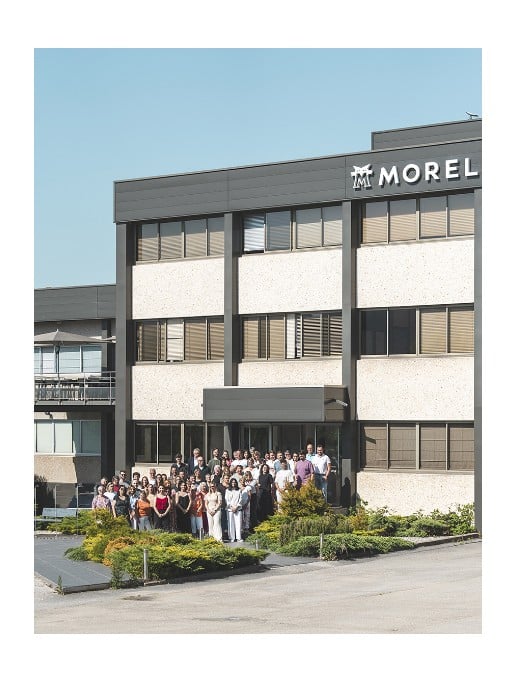
Morel is a French eyewear house based in Morbier, in the Haut-Jura, the region the brand calls the historic birthplace of eyewear. The company dates itself precisely: “In 1880, Jules created his first pince-nez,” an activity he pursued part-time alongside his farm work. That dual life, farming through the warm months and working metal once the first snow fell, was the local tradition the region calls établissage, and it is literally how eyewear-making started in the Jura.
Morel has stayed a family business for four generations since. The brand names each one directly: Marius Morel, “The Industrialist,” who brought the company into large-scale production; Jacques Morel, “The Businessman,” who in 1957 designed the cat-head “M” mark that still identifies Morel frames today; and the current generation, Jérôme, Francis and Amélie Morel. The brand’s own line for it: “MOREL is a family-owned company that has been preserving and reinventing eyewear craftsmanship for 145 years, while staying true to its core values and independence.” At the heart of the company today, in the brand’s words, “Maison Marius Morel embodies the history and soul of MOREL.”
The brand’s tagline is short: “Looking forward since 1880.”
What makes Morel frames different?
Three things, and none of them are decoration.
The hinge was designed to solve a real problem, and the brand still talks about it that way. Morel’s own account credits artistic director Denis Bellone with the idea: “We wanted to apply this design concept to eyewear, aiming to provide new comfort for the wearer while requiring no maintenance for the optician.” The result was a patented hinge built “without screws or welding,” under a philosophy Morel calls Design to Function, “where every element serves its purpose.” A hinge with no screw to work loose is not a marketing detail. It is the difference between a frame that still fits right in a year and one that needs a trip back to the counter.

A single named person still hand-shapes every new design before it becomes a product. Morel identifies her by name: Valérie Prillard, “MOREL’s prototypist and the first woman to receive the prestigious title of Meilleur Ouvrier de France in eyewear,” France’s highest craft honor. Every new model, in the brand’s account, passes through her hands as a full-scale prototype before it is engineered for production. That is a specific, checkable claim, not a vague “handcrafted” label.
The scale is real, and the brand does not hide behind boutique language to hide it. Morel says it runs “the largest eyewear Design Center in France,” where “designers, colorists, and graphic artists work hand in hand to create over 700 models each year,” and that it operates “its own certified quality laboratory, where a dedicated research and development team, trained by Alutec, tests each frame before it goes to market.” Four generations in the same family and a serious industrial design operation are not usually the same sentence. Morel is that sentence.
Who Morel is for
This is the frame for someone who wants a real engineering answer, not just a good-looking one.
It suits anyone who has been burned by a loose hinge before. If a screw working itself out over months is a familiar frustration, Morel built its whole hinge philosophy around removing that failure point entirely.
It suits people who care that a family still runs the place. Four generations, in the same region, with a mark on the temple that literally counts them, is a different thing than a brand name a holding company bought. If provenance matters to how you choose things, Morel gives you an unusually specific one to check.
It suits anyone drawn to French acetate and metal work without needing a logo to announce it. The cat-head mark is small and has been the same shape since 1957. It reads as a maker’s mark, not a billboard.
And it suits the person who likes a brand that will tell you exactly who made the prototype in your hand. Not “handcrafted” as a word on a hangtag. A name, a title, and a specific role in the process.
How to tell if Morel is right for you
A few honest things worth knowing before you come in:
- Look at the temple tip. Find the five milled lines and the colored fourth one. It is a small detail and it is the whole story of the company in about a centimeter of metal.
- Ask about the hinge if hinges have failed you before. Tell us and we will point you toward the screwless construction specifically, rather than a frame chosen on looks alone.
- French acetate work reads differently up close. If you have only tried mass-produced frames, put a Morel next to one and compare the finish at the rim and the temple. That comparison is usually what closes the decision.
- Decide how visible you want the maker’s mark to be. The cat-head M is understated by design. If you want a louder signature, say so and we will point you elsewhere in the shop.
- Come in ready to be fitted. A well engineered hinge still needs to sit right on your particular face. The fitting is the part that is ours, and it takes a few minutes at the counter rather than a guess online.
Frequently asked questions
Where can I try Morel eyewear in San Francisco?
At City Optix, 2154 Chestnut Street, in the Marina District. We are an independent optometry practice and eyewear boutique led by Dr. Jeff Rich, O.D., open Monday through Saturday, 10 to 6. We carry Morel and we will fit the frame properly to your face at the counter. What is on the shelf changes, so come in and see, or call us at (415) 921-1444.
What is Morel?
A French eyewear house based in Morbier, in the Haut-Jura region, founded in 1880 by Jules Morel and still run by his family today, now in its fourth generation. The brand’s own tagline is “Looking forward since 1880.”
What makes Morel’s hinge different?
Morel developed a patented hinge built without screws or welding, under a design philosophy the brand calls Design to Function. The brand says the goal was new comfort for the wearer while requiring no maintenance for the optician, so there is no screw to work loose over time.
Are Morel frames handmade?
Each new Morel design is prototyped by hand by Valérie Prillard, the brand’s prototypist and, in Morel’s words, the first woman to receive the title of Meilleur Ouvrier de France in eyewear, France’s highest craft honor. Morel also operates its own certified quality laboratory that tests every frame before it goes to market.
Come try a pair on Chestnut Street
Morel is a house that rewards a close look. The five lines on the temple, the way the hinge moves without a screw, the finish on the acetate at the rim: none of it survives a product page, and none of it is the sort of thing you can decide on from a screen. Come try them on at City Optix, 2154 Chestnut Street in the Marina, Monday through Saturday, 10 to 6, and find the cat on the temple. What is in the shop changes week to week, so come by and see, or call us at (415) 921-1444. We have spent more than thirty years in the Marina putting faces in frames that were chosen rather than settled for, and this is one we enjoy handing across the counter.