

Every morning, Marina District residents wake to Karl the Fog blanketing the city in cool, gray mist. Temperatures hover in the 50s and 60s while the rest of California bakes. You reach for a sweater instead of sunscreen, squinting through the haze without sunglasses, confident that San Francisco’s legendary fog provides natural sun protection.
You couldn’t be more wrong—and your eyes are paying the price.
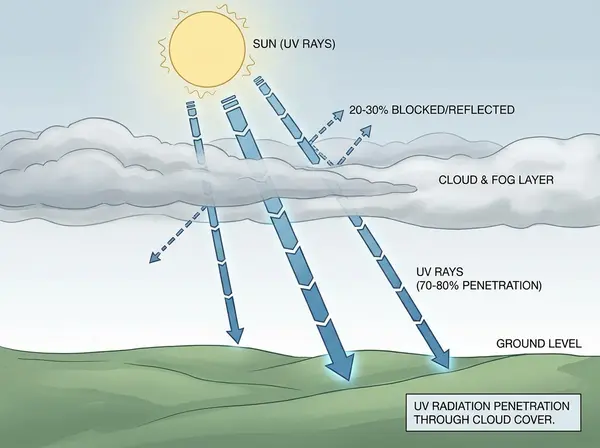
Here’s what most San Francisco residents don’t realize: fog and clouds block only 20-30% of ultraviolet radiation. On an overcast Marina morning when you can barely see the Golden Gate Bridge, up to 80% of the sun’s damaging UV rays are penetrating that gray veil and hitting your unprotected eyes American Academy of Ophthalmology. Even more dangerous, the diffused light creates false security—you don’t feel the sun burning, so you skip protection while UV radiation quietly damages the delicate structures of your eyes.
At City Optix in San Francisco’s Marina District, Dr. Jeff Rich has spent 37 years watching this scenario unfold. Patients arrive for routine exams, shocked to discover early cataracts, pterygium growths, or macular degeneration changes—all linked to decades of unprotected UV exposure they never knew was happening. The fog may keep you cool, but it’s not keeping you safe.
This comprehensive guide reveals everything San Francisco residents need to know about protecting their eyes from UV damage in our unique climate, from understanding the hidden risks to choosing proper protection for year-round eye health.
Why UV Eye Damage Is San Francisco’s Silent Epidemic
San Francisco sits at 37.77°N latitude, putting residents in a moderate UV exposure zone that receives significant ultraviolet radiation year-round. The Bay Area’s unique microclimate creates a dangerous combination: cool temperatures that discourage sun-safety habits combined with substantial UV exposure that accumulates silently over decades.
Unlike skin cancer—which gets dramatic public health campaigns and terrifying statistics—UV eye damage develops quietly. You won’t notice anything wrong for years or even decades. By the time symptoms appear, permanent damage has already occurred to your corneas, lenses, and retinas.
The Cumulative Nature of UV Eye Damage
Every minute of unprotected sun exposure adds to your lifetime UV dose, like deposits in a bank account you can never withdraw from. A 35-year-old Marina District professional who’s lived in San Francisco since college, walking to Crissy Field for morning runs and commuting to a sun-filled office, has accumulated thousands of hours of UV exposure—most of it happening on “not sunny” days when protection seemed unnecessary.
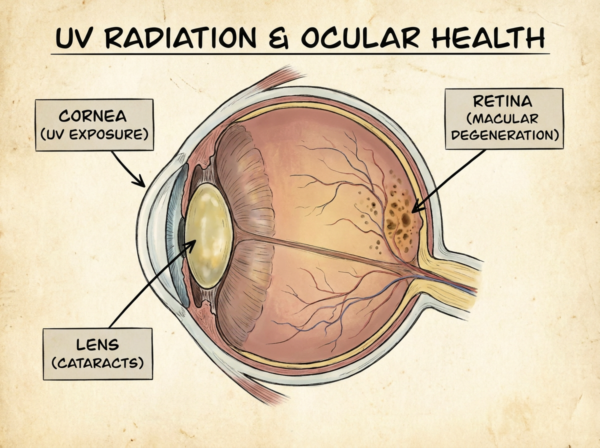
Research published in JAMA Ophthalmology found that cumulative UV exposure over decades increases cataract risk by 60% and macular degeneration risk by 40% JAMA Ophthalmology. The damage isn’t reversible. Once UV radiation alters proteins in your eye’s lens or damages retinal cells, those changes are permanent.
For Russian Hill residents with panoramic bay views working in naturally-lit home offices, the daily UV accumulation is even more insidious. Window glass blocks only UVB radiation (the “burning” rays) while allowing UVA radiation (the “aging” rays that penetrate deeper) to pass through freely. You’re getting UV exposure indoors without realizing it.
Understanding San Francisco’s Hidden UV Threats
San Francisco’s UV landscape differs dramatically from other cities, creating unique risks that even California natives often misunderstand.
Fog Is Not Your Friend
Morning fog creates the most dangerous false sense of security. On typical Marina mornings with visibility under a quarter mile, UV radiation still reaches 70-80% of clear-day levels. You feel cold and damp—the opposite of “sun exposure”—yet your eyes are absorbing significant ultraviolet radiation.
Coastal fog also amplifies exposure through diffusion. Rather than direct sunlight from one angle, foggy conditions scatter UV rays from all directions—top, sides, and even reflected from wet pavement. This omnidirectional UV attack bypasses baseball cap protection and hits your eyes from angles direct sunlight never reaches.
Water Reflection: The Bay Area Double-Whammy
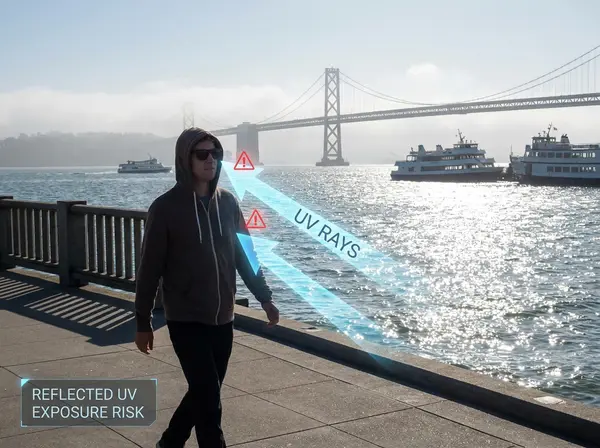
San Francisco’s proximity to water creates intense reflected UV exposure. Water reflects 10-30% of UV radiation upward, hitting the undersides of your eyes that forward-facing sun never reaches Environmental Protection Agency UV Research. For Marina residents walking along Crissy Field, running the Embarcadero, or sailing on the bay, this reflected radiation doubles total UV dose.
Nob Hill residents overlooking the bay receive this reflected exposure even from distance—UV radiation travels for miles before dissipating. That beautiful water view flooding your living room with natural light includes a significant UV component hitting your eyes while you work from home.
Urban Canyon Amplification
San Francisco’s hilly terrain and reflective building surfaces create “urban canyon” effects where UV radiation bounces between buildings and pavement before eventually hitting your eyes. Downtown workers walking through the Financial District at lunch receive UV exposure from multiple reflected sources simultaneously—building glass, concrete sidewalks, metal surfaces, and even car windshields all contribute.
Russian Hill’s steep streets lined with Victorian buildings create similar amplification. That charming walk down Hyde Street toward the bay exposes your eyes to direct sunlight, reflected radiation from building facades, and upward-bouncing rays from steep pavement—a triple threat few residents consider.
Altitude and Latitude Combined
While San Francisco isn’t high altitude, its hills create meaningful UV increases. Every 1,000 feet of elevation increases UV exposure by 10-12%. Marina residents at sea level receive less exposure than Russian Hill and Nob Hill residents 300+ feet higher, but the difference is surprisingly significant over decades—roughly 4% more total UV exposure just from living uphill.
Combined with San Francisco’s latitude, this means year-round moderate-to-high UV levels that never fully drop to “safe” even in winter. December UV indices in San Francisco (3-4) equal July levels in Seattle—meaning you need eye protection every month, not just summer.
The Eye Conditions You’re Developing Right Now
Without proper UV protection, San Francisco residents slowly develop predictable patterns of eye damage. Here’s what UV radiation is doing to your eyes while you walk to work through the fog:
Cataracts: The Inevitable Consequence
Cataracts—clouding of the eye’s natural lens—affect over 50% of Americans by age 75. But UV exposure accelerates cataract development by years or decades. Studies show that people with high lifetime UV exposure develop cataracts 5-10 years earlier than those who protected their eyes National Eye Institute.
UV radiation damages proteins in your lens through oxidative stress, causing them to clump together and create cloudy areas. This process starts in your 20s and 30s, progressing silently until vision impairment becomes noticeable in your 50s and 60s. Every unprotected Marina morning jog or Nob Hill afternoon walk accelerates this timeline.
Dr. Rich sees early cataract changes in San Francisco patients far younger than national averages—not because of genetics or bad luck, but because decades of “fog protection” never actually protected anything.
Pterygium: The Surfer’s Eye in City Professionals
Pterygium—a fleshy growth extending from the corner of your eye across the white part and sometimes onto the cornea—is so common in surfers and outdoor athletes it’s nicknamed “surfer’s eye.” Yet Dr. Rich diagnoses it regularly in Marina District office workers who’ve never touched a surfboard.
The cause? Years of walking to work along sun-drenched (or fog-diffused UV-drenched) sidewalks, sitting near windows, and believing cool temperatures mean sun safety. Pterygium develops on the nasal side of eyes because that’s where reflected UV from pavement and water concentrates as you look forward while walking.
Early pterygium appears as slight redness or irritation that patients attribute to dry eyes or allergies. By the time the growth becomes cosmetically noticeable, it requires surgical removal—and even after surgery, UV exposure causes recurrence in 30-40% of cases without proper protection.
Macular Degeneration: Stealing Your Central Vision
Age-related macular degeneration (AMD) is the leading cause of blindness in Americans over 50, affecting the central retina responsible for sharp, detailed vision. While genetics play a role, UV exposure significantly increases risk and accelerates progression.
UV radiation, especially UVA that penetrates to the retina, generates free radicals that damage light-sensitive cells in the macula. This oxidative damage accumulates over decades, eventually causing cell death and irreversible vision loss. The connection is so established that researchers calculate UV protection throughout life could prevent 20% of macular degeneration cases Archives of Ophthalmology AMD Study.
Russian Hill residents with panoramic bay views face particularly high risk—those beautiful sun-filled rooms with floor-to-ceiling windows deliver massive UV doses daily, accelerating macular damage that won’t become symptomatic until decades later.
Photokeratitis: The Sunburn You Can’t See
Photokeratitis—essentially a sunburn of your cornea—is the only UV eye damage you actually feel. It develops after intense short-term exposure (skiing, beach days, welding) and causes severe pain, tearing, light sensitivity, and blurred vision 6-12 hours after exposure.
San Francisco residents typically avoid acute photokeratitis because sustained intense exposure is rare. But chronic low-grade UV damage causing the same cumulative harm develops silently—you never feel it, so you never protect against it. It’s the difference between second-degree sunburn that hurts immediately and decades of tanning that causes skin cancer eventually.
Skin Cancers on Eyelids and Around Eyes
Eyelid skin is the thinnest on your body and extremely vulnerable to UV damage. Basal cell carcinoma, squamous cell carcinoma, and melanoma all occur on eyelids and the delicate skin surrounding eyes. These cancers require surgical removal that can affect eyelid function and appearance.
Nob Hill residents who diligently apply sunscreen to their faces often skip the eye area—worried about stinging if sunscreen migrates into eyes—creating a zone of unprotected skin receiving full UV exposure. Combined with years of squinting in bright conditions (which creates skin folds that trap UV), this sets the stage for cancer development.
5 San Francisco-Specific UV Myths Putting Your Eyes at Risk
These dangerous misconceptions keep Marina, Russian Hill, and Nob Hill residents unprotected:
Myth 1: “The Fog Protects Me”
Reality: Fog blocks only 20-30% of UV radiation. On overcast days, 70-80% of damaging rays still penetrate clouds and fog. Diffused UV light creates omnidirectional exposure that bypasses hats and reaches your eyes from all angles. Marina residents walking through morning fog need protection just as much as afternoon sun-seekers.
Myth 2: “I Only Need Sunglasses in Summer”
Reality: San Francisco’s winter UV index (3-4) equals many cities’ summer levels. UV exposure doesn’t take holidays. December Marina mornings deliver substantial ultraviolet radiation despite 55°F temperatures. Year-round protection is essential—UV doesn’t care about seasons.
Myth 3: “Cheap Sunglasses Are Fine as Long as They’re Dark”
Reality: Dark lenses without UV protection are more dangerous than no sunglasses at all. Darkness causes your pupils to dilate, allowing more UV into your eyes. If those lenses don’t block UV (which requires specific coatings, not just tint), you’ve increased damage rather than preventing it. Only UV-rated sunglasses provide protection.
Myth 4: “I’m Indoors Most of the Day”
Reality: UVA radiation penetrates window glass freely. That sun-filled Nob Hill home office or Russian Hill living room with panoramic views delivers significant UV exposure all day. Windows block only UVB (burning rays) while allowing UVA (aging/damage rays) to pass through. Indoor UV protection matters.
Myth 5: “I’ll Worry About It When I’m Older”
Reality: UV damage is cumulative and irreversible. By the time symptoms appear in your 50s-70s, decades of damage have already occurred. Protection must start now, regardless of age. Marina District millennials walking to work through fog today are developing the cataracts they’ll discover in 2050.
7 Essential UV Protection Strategies for San Francisco Living
Protecting your eyes from UV damage requires daily habits aligned with San Francisco’s unique environment:
1. Wear UV-Blocking Eyewear Every Day—No Exceptions
Make UV-rated sunglasses or photochromic (transition) lenses as automatic as brushing teeth. Every single day, regardless of weather, season, or perceived “sunniness.” This is the single most important protection strategy.
What qualifies as protective eyewear:
- Sunglasses labeled “100% UV protection” or “UV400”
- Photochromic lenses that darken outdoors and block UV even when clear
- Prescription glasses with UV-blocking coating (most modern lenses include this)
- Wraparound styles that limit peripheral UV exposure
City Optix advantage: Dr. Rich ensures every lens—prescription glasses, sunglasses, readers—includes 100% UV protection. His curated luxury collections offer styles appropriate for professional environments, ensuring Marina District executives don’t have to choose between career appropriateness and eye health.
2. Prioritize Coverage Over Fashion
Larger lenses provide better protection by covering more eye area and limiting peripheral UV exposure. Wraparound styles that curve toward your temples are optimal—they block reflected UV from pavement and water that flat lenses miss.
For San Francisco professionals balancing style and protection:
- Oversized acetate frames offer sophisticated looks with maximum coverage
- Modern wraparound designs have evolved beyond “cyclist” aesthetics
- Fashion-forward shield lenses work in professional contexts
- European designers create elegant large-format frames
Russian Hill creatives and Nob Hill executives don’t need to sacrifice style for protection—City Optix’s independent collections offer designer frames combining maximum coverage with sophisticated aesthetics.
3. Layer Protection for High-Risk Activities
Certain activities multiply UV exposure, requiring enhanced protection:
Water activities (Marina Green walks, sailing, fishing): Wraparound polarized sunglasses to block reflected UV from water, plus wide-brimmed hats creating top shade.
High-altitude recreation (Tahoe skiing, Marin hiking): Category 3-4 sunglasses (the darkest protective ratings) blocking 90-97% of visible light, plus glacier glasses with side shields if above 8,000 feet.
Prolonged outdoor exercise (running, cycling, tennis): Sport-specific wraparound sunglasses that stay secure during movement while blocking UV from all angles.
Outdoor dining/events: Even sitting on patios accumulates UV exposure. Keep sunglasses on during outdoor meals and events, or choose shaded seating when possible.
4. Don’t Trust Windows for Protection

UVA radiation passes through glass freely while only UVB is blocked. Solutions for Russian Hill and Nob Hill residents with expansive windows:
UV-blocking window film: Transparent adhesive film blocks 99% of UV while maintaining views and natural light. Professional installation costs $10-15 per square foot but protects every hour you’re home.
UV-coating for existing windows: Applied professionally, adding UV protection to current glass without changing appearance.
Indoor UV-blocking glasses: Wear clear photochromic lenses or UV-blocking clear lenses while working near windows. They look like regular glasses but protect from indoor UV exposure.
Window treatments: Sheer curtains, blinds, or shades during peak UV hours (10 AM – 4 PM) reduce exposure by 40-60% while maintaining natural light.
5. Maximize Dietary Eye Protection
While nutrition can’t replace UV blocking eyewear, certain nutrients support your eyes’ internal UV defense mechanisms:
Lutein and zeaxanthin: These carotenoids concentrate in the macula, filtering blue/UV light before it damages retinal cells. Found in kale, spinach, collards, egg yolks. Aim for 10mg lutein and 2mg zeaxanthin daily.
Omega-3 fatty acids: Support retinal health and reduce inflammation from UV exposure. Wild-caught salmon, sardines, mackerel, or supplements with EPA/DHA.
Vitamins C and E: Powerful antioxidants neutralizing free radicals generated by UV exposure. Citrus, berries, nuts, seeds, olive oil.
Zinc: Essential for retinal health and antioxidant enzyme function. Oysters, beef, pumpkin seeds, lentils.
Marina District’s abundant farmers markets and health-conscious dining make nutrient-dense eating easy—leverage this advantage for internal eye protection.
6. Schedule Annual Comprehensive Eye Exams
UV damage develops silently over decades. Annual exams with Dr. Rich at City Optix detect early changes while they’re still manageable:
What Dr. Rich examines for UV damage:
- Early cataract formation in lens proteins
- Pterygium or pinguecula growth on eye surface
- Macular pigment density (lower density indicates higher UV damage risk)
- Corneal changes from cumulative UV exposure
- Eyelid skin changes suggesting cancer risk
Early detection enables interventions—increased protection, dietary changes, prescription eye drops—that slow progression before permanent vision loss occurs. By the time UV damage becomes symptomatic, significant irreversible harm has already happened.
7. Educate Your Circle
San Francisco’s UV protection gap stems partly from community ignorance. Share what you’ve learned:
- Explain to Marina neighbors that fog doesn’t protect eyes
- Remind Russian Hill friends that cool temperatures don’t mean low UV
- Share with Nob Hill colleagues that indoor window exposure matters
- Encourage family members to prioritize eye protection year-round
Dr. Rich offers group education sessions for San Francisco businesses, homeowners associations, and community organizations—bringing UV awareness to neighborhoods where misconceptions persist.
Choosing the Right UV Protection for Your Lifestyle
Not all UV protection is created equal. San Francisco residents need eyewear matching their specific exposure patterns:
For Marina District Active Professionals
Primary needs: Protection during commutes, lunch walks, weekend recreation
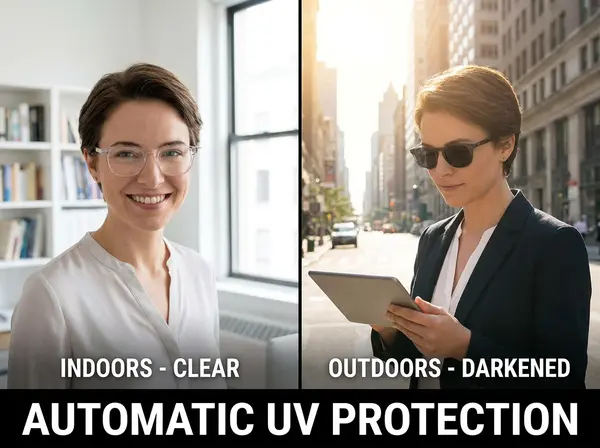
Optimal solution: Photochromic prescription lenses that darken automatically outdoors, staying clear in offices and restaurants. Add polarization for water reflection management.
City Optix recommendation: Transitions XTRActive lenses in professional acetate frames—seamlessly shifting from boardroom to Marina Green without carrying separate sunglasses.
For Russian Hill Remote Workers
Primary needs: All-day indoor UV protection from windows, occasional outdoor errands
Optimal solution: Clear lenses with UV coating for computer work, plus dedicated sunglasses for outdoor activities
City Optix recommendation: Blue-light filtering lenses with UV protection for screen work, paired with elegant everyday sunglasses for errands and walks.
For Nob Hill Executives
Primary needs: Professional appearance, car commutes with windshield exposure, business travel
Optimal solution: Sophisticated prescription sunglasses matching professional wardrobe, clear UV-blocking lenses for indoor meetings
City Optix recommendation: Luxury titanium sunglasses with gradient lenses (darker on top for overhead sun, lighter below for visibility) plus anti-reflective coated clear lenses for meetings.
For Weekend Warriors and Outdoor Enthusiasts
Primary needs: Maximum protection during intense outdoor exposure (skiing, sailing, cycling)
Optimal solution: Sport-specific wraparound sunglasses with category 3-4 darkness, polarization, and secure fit
City Optix recommendation: Prescription sport sunglasses with interchangeable lenses for different conditions—darker for snow and water, lighter for trail running.
The City Optix Approach to Comprehensive UV Protection
Dr. Rich doesn’t just sell sunglasses—he creates personalized UV protection plans addressing your specific San Francisco lifestyle, exposure patterns, and risk factors:
Comprehensive UV assessment includes:
- Review of daily routines and exposure patterns
- Evaluation of indoor UV risks (home/office windows)
- Assessment of recreational activities and travel
- Examination of current eye health and family history
- Analysis of existing eyewear and protection gaps
Personalized recommendations address:
- Prescription sunglasses optimized for your vision needs
- Photochromic lenses for automatic protection
- Specialized coatings (polarization, blue-light filtering, anti-reflective)
- Multiple eyewear options for different activities
- Indoor protection strategies for window exposure
Follow-up includes:
- Annual examinations monitoring for UV damage
- Updates as lifestyle or exposure patterns change
- Evaluation of new lens technologies and frame styles
- Adjustment and maintenance of protective eyewear
This comprehensive approach ensures Marina District, Russian Hill, and Nob Hill residents protect their eyes throughout daily life—not just when they remember to grab sunglasses.
The Economics of UV Protection: Investing Now vs. Paying Later
Quality UV-blocking eyewear represents one of the highest-return health investments possible:
Cost of prevention: $400-800 for excellent UV-blocking sunglasses lasting 10-15 years = $27-80 annually
Cost of UV-related eye disease:
- Cataract surgery: $3,500-5,000 per eye ($7,000-10,000 total)
- Pterygium removal: $2,000-4,000 per eye
- Macular degeneration treatment: $1,500-2,000 per injection, required monthly for years ($18,000-24,000 annually)
- Lost productivity from vision impairment: incalculable
Beyond financial costs, UV-related eye conditions create:
- Permanent vision loss that no treatment fully reverses
- Surgical risks and recovery downtime
- Chronic medications and ongoing monitoring
- Reduced quality of life from impaired vision
- Dependence on others for activities requiring clear vision
For Russian Hill and Nob Hill professionals who routinely invest in preventive healthcare, retirement planning, and quality of life maintenance, UV protection offers exceptional return on investment—preserving vision that money cannot buy back once lost.
Special Considerations for Contact Lens Wearers
Marina District contact lens wearers face unique UV challenges and opportunities:
UV-blocking contact lenses: Some brands offer built-in UV protection, but they only cover the area under the lens—leaving surrounding eye tissue exposed. They’re a helpful addition but not a substitute for sunglasses.
Enhanced sensitivity: Contact lenses can make eyes more sensitive to UV exposure, increasing discomfort during unprotected outdoor time.
Complete protection strategy: Combine UV-blocking contacts with wraparound sunglasses over them, creating layers of protection for both covered and exposed eye areas.
Dr. Rich specializes in fitting UV-blocking contact lenses for San Francisco patients, ensuring this protection layer integrates seamlessly with overall eye health and lifestyle needs.
Take Action: Protecting Your Eyes Starting Today
UV eye damage develops over decades, which means two critical facts:
- Damage you’ve already accumulated is permanent—you can’t reverse it
- Protection you start today prevents decades of future harm—you can stop it
Don’t wait for symptoms. Don’t wait for summer. Don’t wait for “real” sunshine. Start protecting your eyes from San Francisco’s hidden UV threats right now.
Your action plan:
- Schedule a comprehensive eye exam with Dr. Rich at City Optix to assess current eye health
- Invest in quality UV-blocking sunglasses appropriate for your lifestyle
- Add UV-blocking coating to all prescription lenses
- Consider photochromic lenses for automatic all-day protection
- Implement indoor UV protection if you work near windows
- Make wearing protective eyewear as automatic as wearing seat belts
- Share UV protection knowledge with family, friends, and colleagues
The fog will still roll through Marina mornings. The bay will still sparkle from Russian Hill. Nob Hill will still enjoy sun-filled afternoons. But now you’ll experience San Francisco’s beauty while protecting your eyes from its hidden danger—ensuring decades of clear vision ahead.
Ready to protect your eyes from San Francisco’s UV threats? Visit Dr. Jeff Rich at City Optix, 2154 Chestnut Street in the heart of the Marina District. Dr. Rich will assess your UV risk, examine your eye health, and recommend personalized protection strategies ensuring your eyes stay healthy for decades to come. Call (415) 921-1444 to schedule your comprehensive UV protection consultation, or visit us to explore premium UV-blocking eyewear from independent luxury brands. Your future vision depends on the protection you choose today.
About the Author: Dr. Jeff Rich, OD, has provided comprehensive optometric care to San Francisco’s Marina District community since 1988. With over 37 years of experience protecting Bay Area residents’ eyes from UV damage, Dr. Rich specializes in comprehensive eye health examinations, UV risk assessment, and personalized protective eyewear selection. His practice, City Optix, serves health-conscious clients throughout Marina District, Russian Hill, Nob Hill, and northern San Francisco who understand that prevention today ensures vision tomorrow.
FAQ SECTION
Q: Does San Francisco’s fog protect my eyes from UV damage?
A: No. Fog and clouds block only 20-30% of UV radiation, allowing 70-80% of damaging rays to reach your eyes. Foggy San Francisco mornings deliver substantial UV exposure while creating false security because you don’t feel the sun. Wear UV-blocking eyewear every day regardless of weather, fog, or cloud cover.
Q: Do I need UV eye protection year-round in San Francisco?
A: Yes. San Francisco’s winter UV index (3-4) equals many cities’ summer levels. UV exposure doesn’t drop to “safe” levels even in December. Your eyes need protection every single day, all year long, regardless of season, temperature, or weather conditions. UV doesn’t take holidays.
Q: Can I get UV eye damage while indoors near windows?
A: Yes. UVA radiation penetrates window glass freely while only UVB is blocked. If you work in a sun-filled office or have panoramic bay views, you’re receiving significant UV exposure indoors all day. Consider UV-blocking window film or wear UV-blocking clear lenses while working near windows.
Q: What eye conditions does UV exposure cause?
A: UV radiation causes cataracts (clouding of the lens), macular degeneration (retinal damage causing blindness), pterygium and pinguecula (eye surface growths), photokeratitis (corneal sunburn), and eyelid skin cancers. All of these develop silently over decades from cumulative UV exposure without symptoms until permanent damage has occurred.
Q: Are dark sunglasses without UV protection dangerous?
A: Yes, very dangerous. Dark lenses without UV coating cause your pupils to dilate, allowing more UV radiation into your eyes. If those lenses don’t block UV (which requires specific coatings, not just tint), you’ve increased damage rather than preventing it. Only buy sunglasses labeled “100% UV protection” or “UV400.”
Q: What should I look for when buying UV-blocking sunglasses?
A: Look for sunglasses labeled “100% UV protection” or “UV400” (blocking all wavelengths up to 400nm). Choose larger lenses or wraparound styles for maximum coverage. Polarization helps with glare but doesn’t add UV protection. Purchase from reputable optical practices like City Optix where Dr. Rich verifies all eyewear meets protection standards.
Q: How often should I have my eyes examined for UV damage?
A: Adults should have comprehensive eye exams annually. UV damage develops silently over decades—early detection during regular exams catches problems while they’re still manageable. City Optix examinations include UV damage assessment, checking for early cataracts, pterygium growth, macular changes, and other sun-related eye conditions before vision symptoms appear.
Q: Where can I get comprehensive UV eye protection in San Francisco?
A: City Optix at 2154 Chestnut Street in San Francisco’s Marina District specializes in UV risk assessment and protective eyewear. Dr. Jeff Rich evaluates your lifestyle, exposure patterns, and eye health, recommending personalized UV protection strategies. All City Optix prescription lenses and sunglasses include 100% UV protection.