
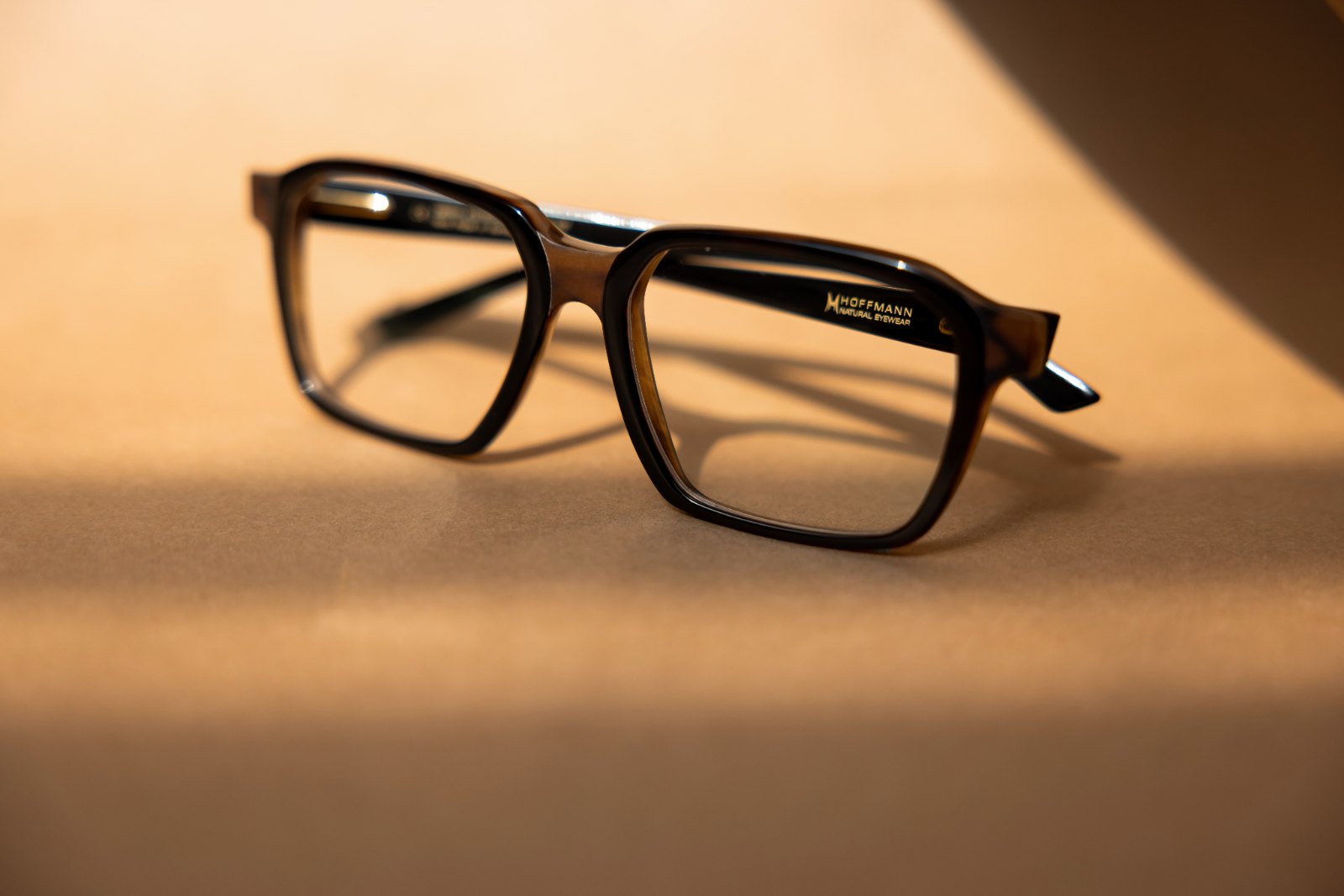
Someone will pick up a Hoffmann, hold it toward the window, and go quiet for a second. That is the horn doing it. Backlit, a horn frame stops reading as a frame and starts reading as a cross section of something that grew: bands of caramel and smoke and near black moving through the material at their own angle, matching nothing. We carry Hoffmann Natural Eyewear at City Optix, on Chestnut Street in San Francisco’s Marina District, and it is one of the few houses in the shop where the material is the entire conversation.
Here is what Hoffmann is, what the frames actually do differently, and how to tell whether one belongs on your face. If you want to see where Hoffmann sits among the other independent houses we carry, start there.
What is Hoffmann Natural Eyewear?
Hoffmann Natural Eyewear is a German house that has been making glasses since 1978 in the Volcanic Eifel, a region in western Germany. The brand says it has manufactured exclusively in Germany that entire time, with every stage of production carried out under one roof in its Eifel atelier, from the first design and the selection of materials through to the finished frame.
The materials are the point, and they are the reason for the “Natural” in the name. Hoffmann works in natural horn above all, alongside wood and slate, and in several lines pairs horn with titanium or with silver.
By the brand’s own account, each frame is created by hand in around 280 individual steps.
What makes Hoffmann frames different?
Three things, and they are all downstream of the same decision.
The material is never twice the same. Horn is not manufactured, it is grown, so the grain and the color arrive already decided. Hoffmann leans into this rather than hiding it. The house describes small differences in structure, color, and feel as what makes each pair unique, and puts it more plainly still: perfection, at Hoffmann, is not achieved through uniformity but through deliberate deviation. In practice that means the piece in your hand is its own piece, and the next one in that model will read differently. There is no second one exactly like it.
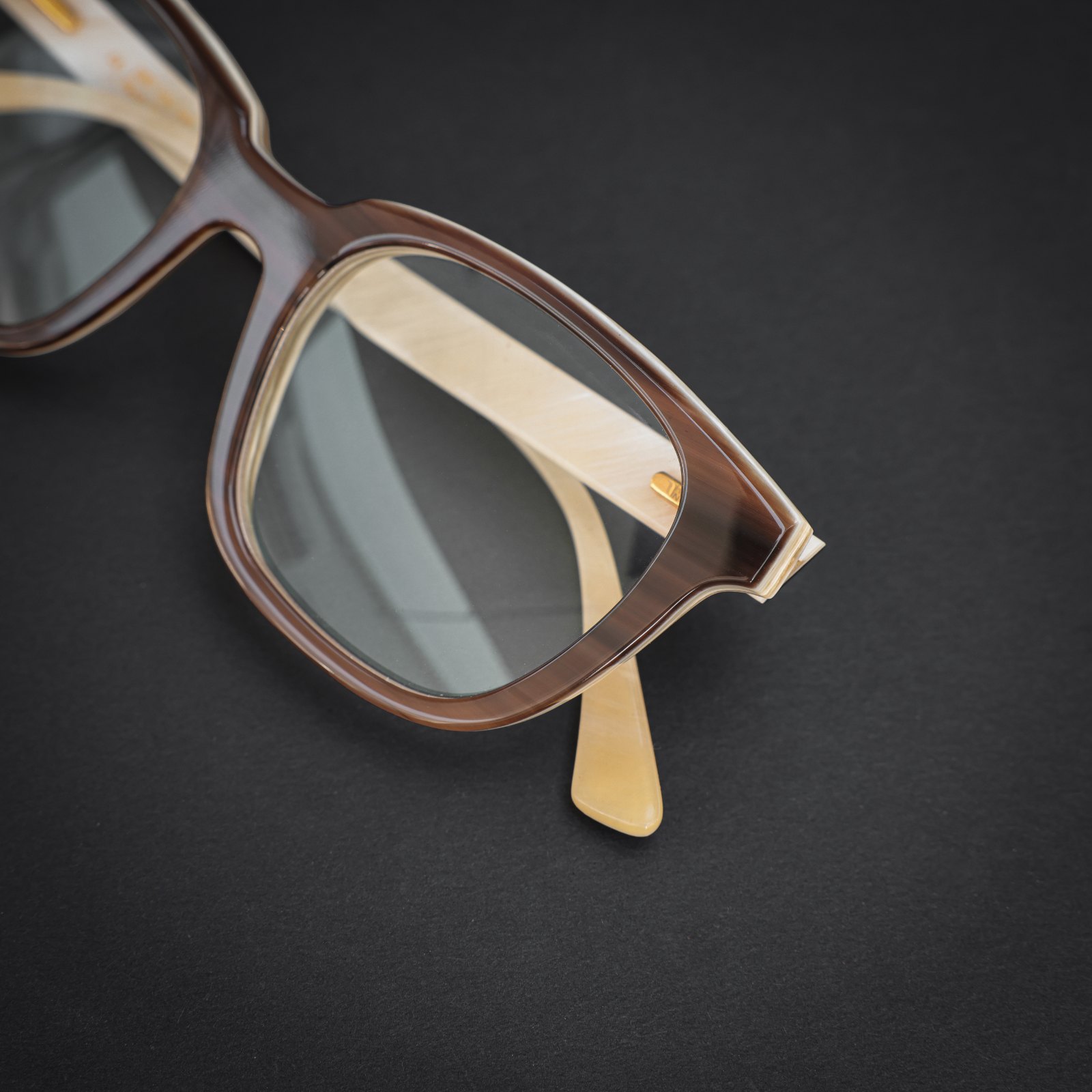
The hand work is not decorative. Around 280 steps is a real number of steps. Hoffmann says natural materials are sensitive and require a delicate touch, that knowledge is passed down through generations in the atelier, and that “Handmade in Germany” is a living standard rather than a seal of origin. What you notice at the counter is edges. To our eye, horn takes a finish acetate does not quite imitate, and the places where a frame gets handled every day, the rims, the ends of the temples, are where you can feel whether someone actually spent time there.
The design deliberately stays quiet. Hoffmann’s own phrase for it is “understatement as a statement.” The house says its frames underline the wearer’s style without drawing focus toward a logo, that clear proportions and balanced thicknesses do the work, and that beauty comes from consistency in detail rather than from effects. That is a rare thing in a material this striking. The horn is dramatic; the shape around it is not.
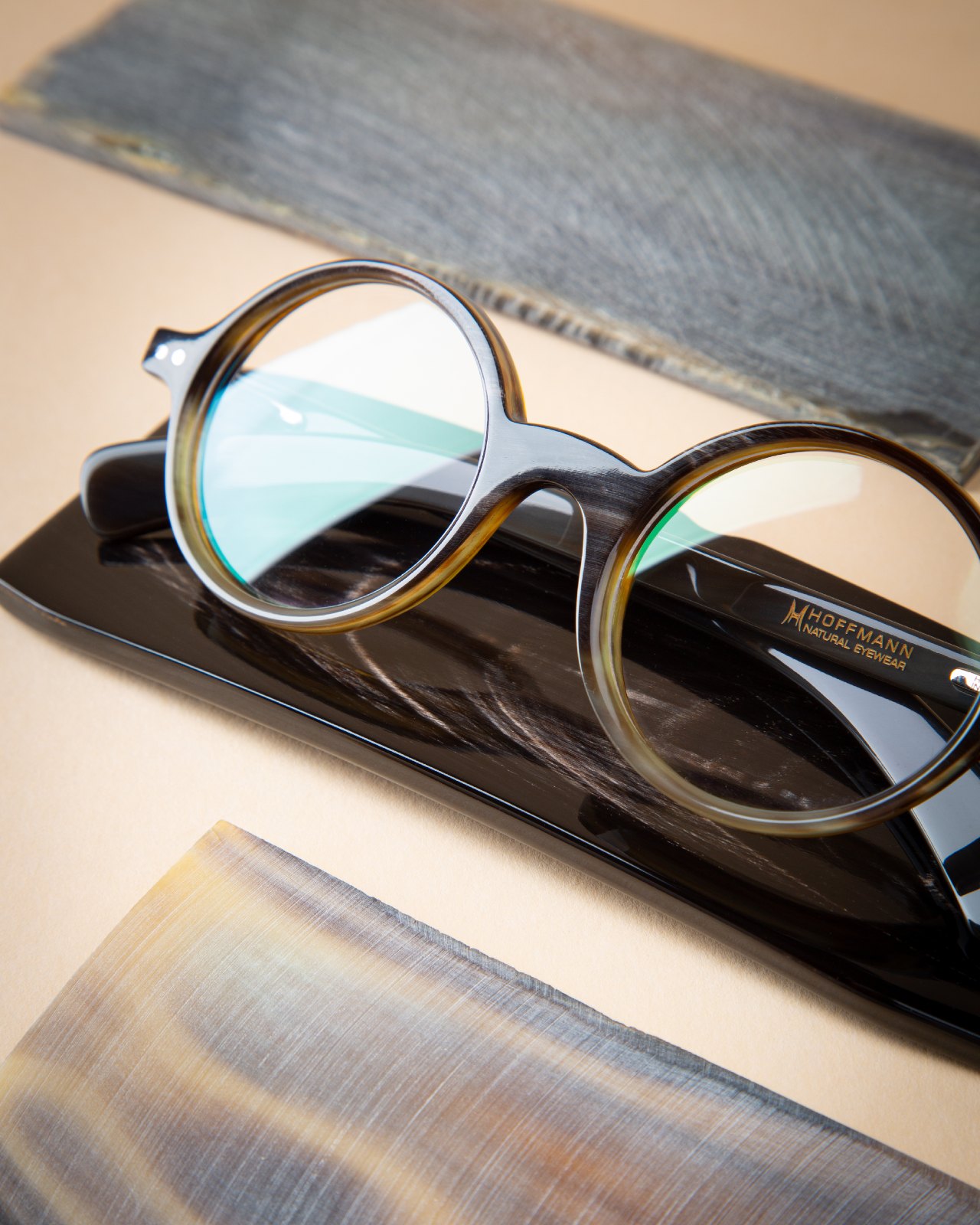
On sourcing, which people do ask about: Hoffmann says the horn used for its natural horn frames comes mostly from the Asian water buffalo, an animal that does not come under the Washington Convention for the protection of species (CITES). The house adds that in their native lands these domestic animals mainly serve as a resource for leather production, so the horn, in Hoffmann’s framing, is a material that would otherwise be a leftover and is instead treated as a valued one. The brand also says wood is the principal material for certain models, and that its entire production area is heated by a geothermal system. Those are the house’s own statements, and they are worth reading yourself if the question matters to you.
The collections run from S-line (natural horn, avant-garde through to timeless) and Bold (full horn, eye-catching, in countless horn colors) to V-line (thin, built around the house’s Triplex-Horn technology), Ti-line (natural horn with titanium, minimal and very light), Elements (pure silver, and silver with natural horn), the Sarah Settgast line drawing on Art Nouveau and Art Deco, and a collaboration with Thierry Lasry in horn and titanium.
Who Hoffmann Natural Eyewear is for
This is the frame for someone who wants the object to be interesting rather than the label.
If you have ever been quietly put off by a logo on a temple, Hoffmann is built on the opposite instinct. The house says the frame should not force itself into the foreground. What people will notice is a color they cannot place and a warmth that plastic does not have. They will not be able to tell you the brand, which for a certain kind of wearer is the whole appeal.
It suits people who like knowing where a thing came from. One atelier, one region, one workshop of hands, since 1978. If you buy furniture that way, or shoes, you already understand the trade you are making.
It suits anyone who wants something nobody else in the room will be wearing. Not because it is rare on purpose, but because the grain of the material is never repeated.
And it suits the person who has decided to stop replacing glasses so often. Hoffmann talks about longevity as the real sustainability argument: timeless design and careful making so a frame gets worn for years. That is a fair way to think about the cost of any good frame.
How to tell if Hoffmann is right for you
A few honest things worth knowing before you come in:
- Look at it against the light. This is the single most useful thing you can do with a horn frame. Hold it up to the window and look at how the color moves through it. That is the part a product photo cannot give you, and it is usually what decides people.
- Pick the pattern, not just the shape. With most brands you choose a model and a color. With Hoffmann you are also choosing a specific piece of material. Take the extra minute.
- Decide how loud you want to be. Bold is full horn and meant to be seen. Ti-line is horn and titanium, ultra light and minimal. Same house, very different intentions. Tell us which end you are aiming for and we will point you the right way.
- Natural materials want a little care. Horn and wood are not indestructible plastic. They reward being kept in a case and brought in occasionally for a check. If you are hard on glasses, say so up front and we will be straight with you about whether this is the right house for your life.
- Come in ready to be fitted. A beautifully made frame that sits wrong is still a frame that sits wrong. The fitting is the part that is ours, and it takes a few minutes at the counter rather than a guess online.
Frequently asked questions
Where can I try Hoffmann Natural Eyewear in San Francisco?
At City Optix, 2154 Chestnut Street, in the Marina District. We are an independent optometry practice and eyewear boutique led by Dr. Jeff Rich, O.D., open Monday through Saturday, 10 to 6. We carry Hoffmann and we will fit the frame properly to your face at the counter. What is on the shelf changes, so come in and see, or call us at (415) 921-1444.
What are Hoffmann frames made of?
Natural materials, above all natural horn. Hoffmann also works in wood and slate, and pairs natural horn with titanium in its Ti-line and with silver in its Elements line.
Where are Hoffmann frames made?
In Germany. Hoffmann says it has manufactured exclusively in Germany since 1978, with every stage of production carried out under one roof in its atelier in the Volcanic Eifel region, and that each frame is created by hand in around 280 individual steps.
Where does Hoffmann’s buffalo horn come from?
Hoffmann says the horn used for its natural horn frames comes mostly from the Asian water buffalo, which does not come under the Washington Convention for the protection of species (CITES) and which in its native lands mainly serves as a resource for leather production. The house describes the horn as a material that would otherwise be a leftover product and is instead treated as a valued one.
Come try a pair on Chestnut Street
Hoffmann is a brand that has to be handled. The grain, the weight, the way the color changes as you turn the frame toward the window: none of it survives a screen, and none of it is the sort of thing you can decide on from a product page. Come try them on at City Optix, 2154 Chestnut Street in the Marina, Monday through Saturday, 10 to 6, and hold one up to the light. What is in the shop changes week to week, so come by and see, or call us at (415) 921-1444. We have spent more than thirty years in the Marina putting faces in frames that were chosen rather than settled for, and this is one we enjoy handing across the counter.